
NeuroMyst calls itself a small team of hardware and neuroscience geeks, and the Pro is the device that put them on the map: a pocket-sized stimulator that does both tDCS and tACS for well under the price of most single-mode devices.
I first reviewed it in 2023. Since then the line-up has grown (there’s now a Pro+), prices have shifted and Flow has become FDA-approved, which changes how the Pro compares. So here’s the updated picture.
Disclosure: links to NeuroMyst on this page are affiliate links. If you buy through them, this site may earn a commission at no extra cost to you. It doesn’t change my verdict.

In this article
NeuroMyst Pro at a Glance
| Type | tDCS + tACS stimulator (wellness device) |
| Price | Around $160 (Pro) / $225 (Pro+) |
| Current | 0.1 to 4 mA, in 0.1 mA steps |
| Session length | 1 to 60 minutes, with ramp-up and ramp-down |
| Presets | 3 tDCS and 3 tACS presets, plus full manual mode |
| Power | Rechargeable battery (USB-C on current units) |
| Medical status | Not a medical device |
| My rating | 4/5: best value for flexible home stimulation |
What Is NeuroMyst Pro?
It’s a handheld stimulator with a colour screen and two wired electrodes that you hold in place with a headband. In tDCS mode it delivers a steady current. In tACS mode the current oscillates at a frequency you choose. If the difference is fuzzy, my tDCS vs tACS guide explains it.
NeuroMyst is clear that this is a general wellness product for healthy adults, not a medical device. It doesn’t come with a treatment protocol for any condition. You choose where the electrodes go.
NeuroMyst Pro vs Pro+: Which One?
| Pro | Pro+ | |
|---|---|---|
| Modes | tDCS, tACS | tDCS, tACS, tCFS, tPCS |
| Price | ~$160 | ~$225 |
| Best for | Most people starting out | Experienced users exploring newer waveforms |
The Pro+ adds two newer research waveforms (tCFS and tPCS) and more control over each session. The research on those modes is thinner than for tDCS and tACS, so unless you already know why you want them, the standard Pro is the sensible buy.
NeuroMyst also sells a model called Aero, which I haven’t tested yet.
Unboxing: What’s in the Kit
- NeuroMyst Pro device
- Charging cable
- Electrode lead wires
- 2 electrodes, 2 sponge cases, 4 sponges
- Headband
- Quick setup booklet and hard carrying case
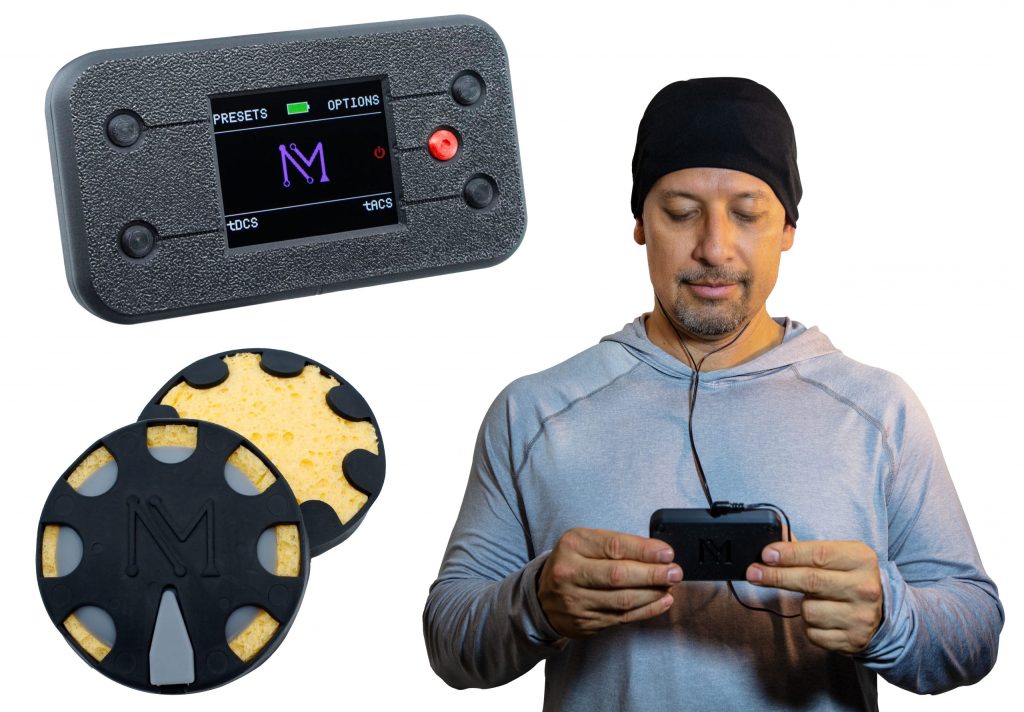
Everything arrives in a compact hard-shell case with mesh pockets, which makes it genuinely travel-friendly. Replacement sponges are sold separately.
My Experience Using It
Setup had a few bumps. I made my saline, prepped the electrodes and then had to work out what goes where, mostly from NeuroMyst’s video tutorials. The booklet has improved since, with diagrams, a beginner glossary and QR codes linking to videos.
I chose the Smile/Zen preset and ran a 15-minute tDCS session at 1.0 mA. The wide headband kept the electrodes in place. I liked that the screen shows the current ramping up and down, so you know what to expect.
The session was calm and comfortable, and I came away curious to try the other presets. That’s a subjective impression from a healthy user, not evidence of an effect. After the first session, everything felt straightforward.
How to Use NeuroMyst Pro Safely
- Start low. Most tDCS research uses 1 to 2 mA for about 20 minutes. The 4 mA ceiling is a limit, not a target.
- Keep sponges properly wet with saline and replace them when worn, to avoid skin irritation.
- Use evidence-based montages from the electrode placement guide rather than guessing.
- Skip it if you have epilepsy, metal implants in the head, an implanted electronic device, or broken skin under the electrodes, and talk to a doctor if you’re managing a medical condition.
NeuroMyst Pro vs Flow
This is the comparison I get asked about most. They’re built for different people.
- Flow is an FDA-approved, CE-marked medical treatment for depression with one fixed montage and an app-guided plan.
- NeuroMyst Pro is a cheaper, flexible wellness tool with tDCS and tACS, any montage, and no treatment protocol.
If depression is the reason you’re shopping, Flow plus a doctor is the safer route. If you want to explore, NeuroMyst gives you more room for less money. More options in the best Flow alternatives.
What Users Say
Amazon reviews are broadly positive. One reviewer, a neuroscientist, praised the engineering and the value, and wished for a timing output so several units could be synchronised for research. Another said NeuroMyst’s support team was friendly and responsive, and that she now uses a daily preset as part of her routine.
The most common complaints are about the wires and the setup learning curve rather than the device itself.
Pros and Cons
Pros
- tDCS and tACS in one device, at a single-device price
- Fine control: 0.1 mA steps, 1 to 60 minutes, adjustable tACS frequency
- Ramp-up and ramp-down, plus a connection-quality readout
- Rechargeable, compact, comes with a travel case
- Clear presets and video tutorials for beginners
Cons
- Not a medical device, no clinical trials of this specific unit
- Wires can hang in front of your face
- Traditional electrodes take some practice to place well
Final Verdict
In 2026 the NeuroMyst Pro is still the best-value flexible stimulator I can recommend. It’s not a sleek headset, and it’s not a treatment. But for a healthy adult who wants to explore tDCS and tACS carefully, it does a lot for around $160.
Frequently Asked Questions
How much does NeuroMyst Pro cost?
Around $160 for the Pro and $225 for the Pro+ as of October 2026. Prices vary slightly between NeuroMyst’s own shop and retailers like Caputron and Amazon.
Is NeuroMyst Pro FDA approved?
No. It’s sold as a general wellness device, not a medical device. Read more in are brain stimulation devices legal?
Which montages can I use with NeuroMyst?
Any. The device comes with presets, but you place the electrodes yourself. Start with the research-backed placements in my electrode placement guide.
Can I buy NeuroMyst Pro in the UK?
It’s a US company, so availability and shipping costs vary by country. Check the official shop or Amazon in your region, and see my UK tDCS devices guide for local options.
NeuroMyst Pro or Brain Driver?
The Brain Driver v2.1 is simpler, with four fixed tDCS levels. NeuroMyst costs a bit more but adds tACS, finer control and a rechargeable battery.
Company: NeuroMyst (USA)
Website: neuromyst.com
Email: info@neuromyst.com
This review is for information only and isn’t medical advice. See our medical disclaimer. Prices checked October 2026 and may change.