

Search for a tDCS headset and you’ll find three very different things: medical headsets for depression, simple stimulators with a strap-on headband, and “brain” headphones that don’t stimulate anything at all.
I’ve sorted through them so you don’t have to. Below are the six headsets I’d actually consider in 2026, who each one is for, and an honest answer to a question I get a lot: do tDCS headphones exist?
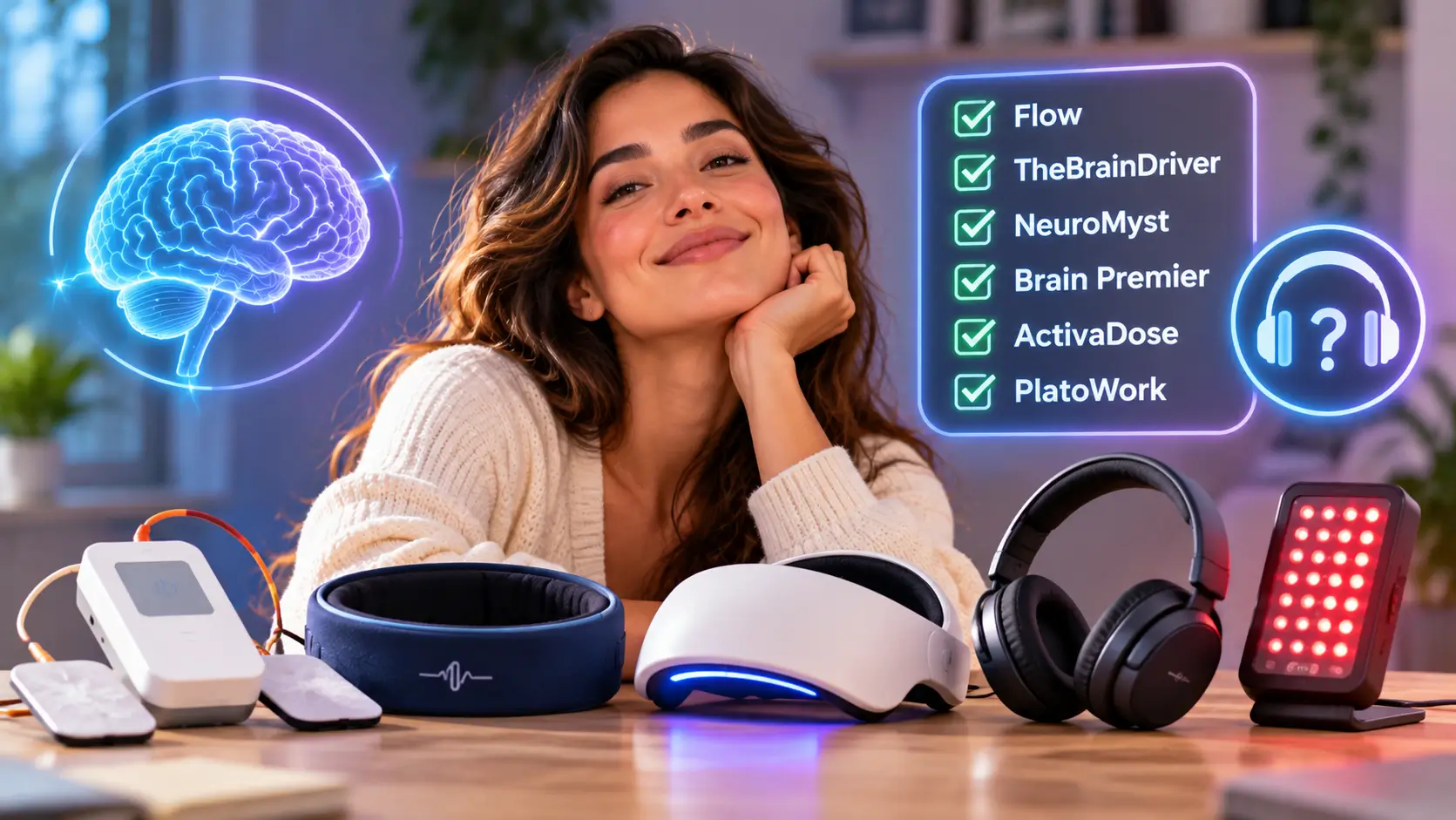
In this article
- Quick Picks
- What Counts as a tDCS Headset?
- 1. Flow FL-100: Best for Depression
- 2. TheBrainDriver v2.1: Best First Device
- 3. NeuroMyst Pro: Best for Flexibility
- 4. Brain Premier E1: Best Budget Kit
- 5. ActivaDose II: Best for Research-Style Setups
- 6. PlatoWork: Best for Focus and Creativity
- Do tDCS Headphones Exist?
- How to Choose the Right tDCS Headset
- A Quick Word on Safety
- Frequently Asked Questions
Quick Picks
| Headset | Best for | Rough price |
|---|---|---|
| Flow FL-100 | Depression, with the strongest evidence | £399 in the UK; US by prescription |
| TheBrainDriver v2.1 | A simple, safe first device | About $125 to $130 |
| NeuroMyst Pro | Flexibility (tDCS and tACS) | About $160 to $225 |
| Brain Premier E1 | Budget starter kit | Around $125 |
| ActivaDose II | Research-style setups | Higher; check the kit |
| PlatoWork | Focus and creativity | Around $400; check stock |
Prices change often, so check the seller before you buy. Some links are affiliate links, which support the site at no extra cost to you.
What Counts as a tDCS Headset?
Every tDCS device has the same core parts: a stimulator that delivers a weak, steady current (usually 1 to 2 milliamps) and two electrodes on your scalp. The difference is how the electrodes are held in place.
- All-in-one headsets like Flow and PlatoWork build the electrodes into a fixed frame. You get the same placement every time, but you can’t change it.
- Stimulator plus headband kits like TheBrainDriver, NeuroMyst and Brain Premier use a strap to hold sponge electrodes. They’re cheaper and let you try different placements, but you need to place them correctly yourself.
New to all this? Start with what tDCS therapy is.
1. Flow FL-100: Best for Depression
Flow is the headset with the strongest evidence behind it. In a 2024 trial in Nature Medicine, 174 adults with depression used it at home for 10 weeks, and remission rates were about twice as high with active stimulation as with sham. The FDA approved it in December 2025, and it launched in the US in September 2026.
The trade-off: it’s built for one job. The electrodes sit in a fixed position for depression, and in the US you need a prescription (a clinician can assess you in person or by telehealth). In the UK it’s £399 to buy or £79 a month to rent.
Choose it if: depression is your main reason for trying tDCS and you want guided, evidence-based sessions. Read my full Flow review.
2. TheBrainDriver v2.1: Best First Device
If you want to try tDCS without overthinking it, this is where I’d start. TheBrainDriver has four fixed current levels (0.5 to 2.0 mA), a 20 or 30-minute timer that shuts off automatically, and a kit with a headband and sponges that works out of the box.
It’s deliberately simple. There’s no app and no tACS mode. For a first device, that’s a feature: fewer settings means fewer mistakes. Use code tdcscom for 5% off.
Read my TheBrainDriver review.
3. NeuroMyst Pro: Best for Flexibility
NeuroMyst Pro is the opposite of Flow. It offers both tDCS and tACS, adjustable current up to 4 mA, adjustable session length and a rechargeable battery. That makes it the one to pick if you want to follow different research protocols, for mood, focus or sleep.
The catch is that more control means more responsibility. Most home protocols stay at or below 2 mA, so read up before you turn anything up.
4. Brain Premier E1: Best Budget Kit
Brain Premier is a straightforward tDCS starter kit sold through Caputron, with a stimulator, headband and sponge electrodes. It covers the basics at a low price, which makes it a reasonable way to find out whether tDCS suits you before spending more.
See Brain Premier at Caputron or read my Brain Premier review.
5. ActivaDose II: Best for Research-Style Setups
Caputron’s ActivaDose II is the kind of stimulator you’ll see in research settings. It’s built for people who want precise control and are comfortable choosing electrode placements from published studies. It costs more than the consumer kits and isn’t the friendliest choice for a beginner.
See the ActivaDose II starter kit or read my ActivaDose review.
6. PlatoWork: Best for Focus and Creativity
PlatoWork, from Danish company PlatoScience, is an all-in-one headset aimed at focus, learning and creativity rather than depression. The app guides you through sessions, and the fixed design makes placement easy.
Its evidence for those goals is thinner than Flow’s for depression, and stock can be patchy, so check availability first. Read my PlatoWork review.
Do tDCS Headphones Exist?
Not really, at least not anymore. The best-known example was Halo Sport, headphones with built-in stimulation pads for athletes. Halo was acquired by Flow in 2022 and the headphones are no longer sold.
What you’ll find instead are two kinds of “brain” headsets that don’t use tDCS:
- EEG headphones, such as Neurable’s MW75 Neuro, from about $499. They read your brain activity to track focus and fatigue. They don’t stimulate it. The same goes for headbands like Muse.
- Light and sound headsets, such as BrainTap, which use pulsing light and audio for relaxation. No electrical current is involved.
So if you’re comparing tDCS headphones with something like the MW75 Neuro, you’re comparing a device that changes brain activity with one that measures it. If stimulation is what you want, pick one of the six headsets above.
How to Choose the Right tDCS Headset
- Start with your goal. For depression, Flow has the evidence. For general experimenting, a stimulator plus headband gives you more room.
- Check the safety basics. Look for a steady, limited current (most home use stays at 2 mA or below), an automatic timer and a gentle ramp up and down.
- Think about placement. Fixed headsets are easier. Headband kits need you to follow a placement guide carefully.
- Count the running costs. Sponges and pads wear out, so check the price of replacements.
- Avoid no-name devices. My guide on how to spot fake or dangerous tDCS devices shows the red flags.
Still weighing Flow against the rest? See my Flow alternatives guide.
A Quick Word on Safety
tDCS has a good safety record at standard settings. The common side effects are tingling, itching or redness under the electrodes. Don’t use it if you have epilepsy, metal implants in your head or an implanted device like a pacemaker, and talk to your doctor first if you’re pregnant or taking medication. More in my piece on at-home brain stimulation.
Frequently Asked Questions
What is the best tDCS headset?
For depression, the Flow FL-100, which is FDA-approved and backed by a large clinical trial. For a first general-purpose device, TheBrainDriver v2.1 is simple and affordable, and NeuroMyst Pro suits people who want more control.
Are there tDCS headphones?
Not currently. Halo Sport was the best-known pair, but it’s discontinued. Most “brain” headphones today, like the Neurable MW75 Neuro, read brain activity with EEG instead of stimulating it.
Do I need a prescription for a tDCS headset?
For Flow in the US, yes. Consumer stimulators like TheBrainDriver and NeuroMyst are sold directly, but it’s still wise to check with your doctor, especially if you have a medical condition.
How much does a tDCS headset cost?
Starter kits begin at around $125. More flexible devices cost about $160 to $225, and Flow costs £399 in the UK. Research-grade stimulators cost more.
This article is for information only and isn’t medical advice. See our medical disclaimer.