

“Neuromodulation” covers a lot of very different gadgets: headsets that send current through your brain, clips that sit on your earlobes, pads for your back and headbands that pulse magnetic fields. They’re often sold with the same big promises, but they work differently and the evidence behind them varies hugely.
Pain doctors are paying attention too. This year the American Academy of Pain Medicine published its first consensus guidelines on neuromodulation technologies, and several newer methods earned cautious, low-certainty support. So instead of one ranked list, I’ve sorted the best home devices by what you actually want help with.
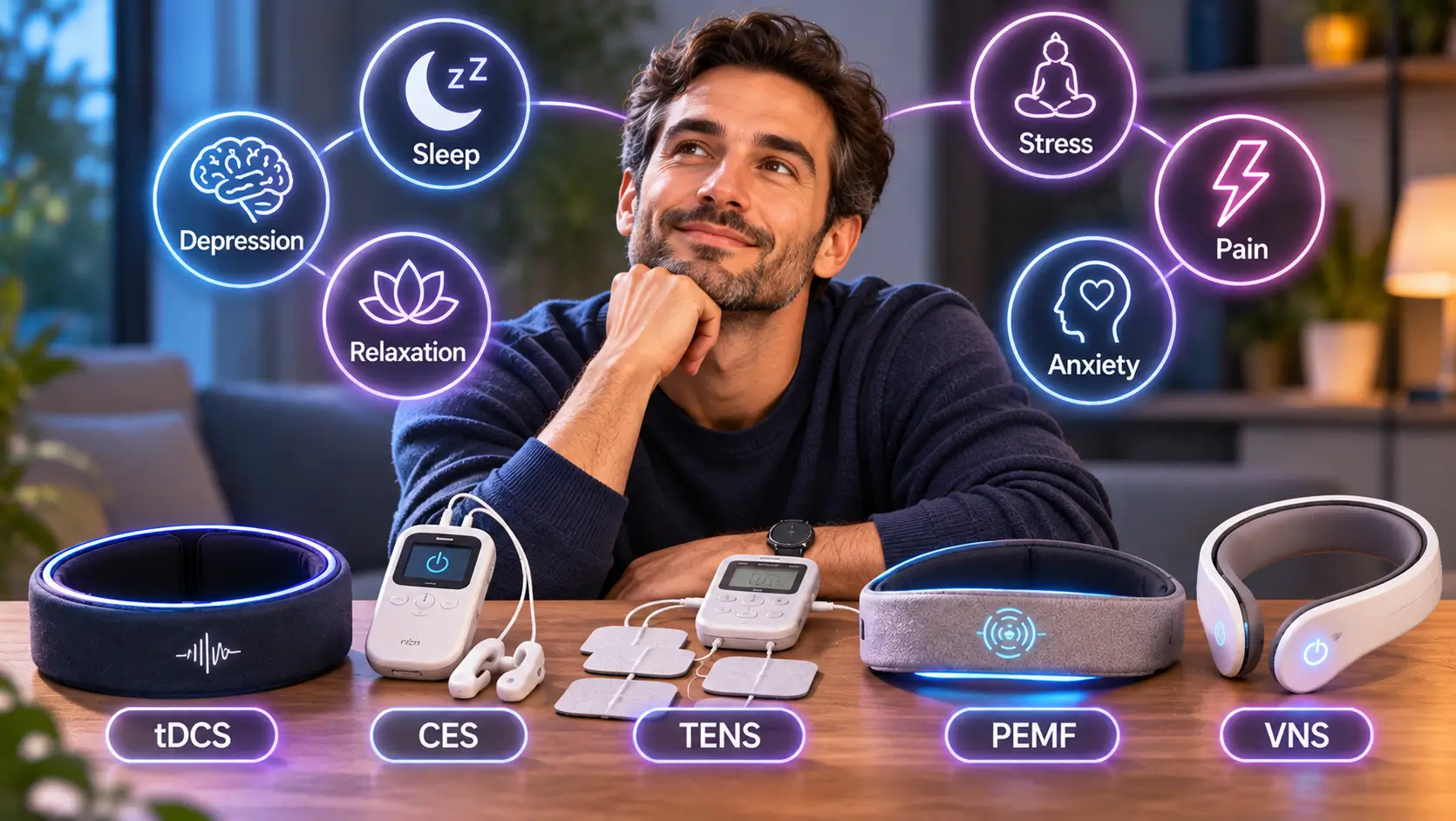
In this article
- Quick Picks by Goal
- 1. Best for Depression: tDCS (Flow)
- 2. Best for Anxiety and Sleep: CES (Alpha-Stim or Fisher Wallace)
- 3. Best for Everyday Pain: TENS
- 4. Best for Experimenting: General tDCS Devices
- 5. Best for Relaxation and Focus: PEMF (NeoRhythm)
- 6. Best for Stress: Vagus Nerve Stimulation
- How to Choose a Home Neuromodulation Device
- Safety First
- Frequently Asked Questions
Quick Picks by Goal
| Your goal | Best type | Device to look at | Evidence |
|---|---|---|---|
| Depression | tDCS | Flow FL-100 | Strong (FDA-approved) |
| Anxiety and insomnia | CES | Fisher Wallace Stimulator | Moderate (CES is FDA-cleared via Alpha-Stim; Fisher Wallace’s new OAK is awaiting clearance) |
| Everyday pain | TENS | Any reputable TENS unit | Moderate, varies by pain type |
| Experimenting with tDCS | tDCS | NeuroMyst Pro or TheBrainDriver | Depends on the protocol |
| Relaxation and focus | PEMF | NeoRhythm | Early |
| Stress | Vagus nerve stimulation | Ear or neck VNS devices | Early |
Some links are affiliate links, which support the site at no extra cost to you.
1. Best for Depression: tDCS (Flow)
Transcranial direct current stimulation sends a weak, steady current through electrodes on your forehead to nudge activity in the brain’s mood-regulating areas. Of all home neuromodulation, it has the strongest evidence for one specific condition: depression.
The Flow headset was FDA-approved in December 2025 after a large Nature Medicine trial in which remission was about twice as common with real stimulation as with sham. In the US it needs a prescription. Not every tDCS protocol works, though: a recent Hebrew University trial that paired tDCS with brain-training games found no added benefit. I break that down in does at-home tDCS actually work?
2. Best for Anxiety and Sleep: CES (Alpha-Stim or Fisher Wallace)
Cranial electrotherapy stimulation uses a tiny alternating current, usually through earlobe clips or pads on the temples. In the US, CES can be FDA-cleared for anxiety and insomnia, which makes it the most established home option for those two problems. Alpha-Stim AID is the best-known cleared device (prescription-only in the US, around $882).
The Fisher Wallace Stimulator is the other big name and is easy to use: two sponge electrodes on the temples, 20 minutes a session. One caveat: the original stimulator was sold under an FDA pathway that closed in 2019, and the company’s new device, OAK, is awaiting FDA clearance for anxiety. Check its current status before you buy. More on how CES works in my guide to cranial electrotherapy stimulation.
Read my Fisher Wallace review.
3. Best for Everyday Pain: TENS
Transcutaneous electrical nerve stimulation is the oldest and cheapest option on this list. Pads on the painful area stimulate nerves in the skin, which can dampen pain signals while you use it. It’s widely used for back pain, period cramps and muscle aches, and a decent unit costs far less than anything else here.
The catch is that relief tends to last only as long as the session, and results vary by pain type. The AAPM guidelines call TENS a common therapy for chronic pain rather than giving it a specific new recommendation. For pain that won’t go away, see a doctor first.
4. Best for Experimenting: General tDCS Devices
If you want to follow research protocols yourself, for mood, focus or chronic pain, a general-purpose tDCS device gives you room to do it. Brain stimulation for pain is an active research area: a recent meta-analysis on chronic low back pain looked at transcranial electrical stimulation, though results for pain are less consistent than for depression.
- NeuroMyst Pro: tDCS and tACS, adjustable current and session length. Best for flexibility. Review.
- TheBrainDriver v2.1: four fixed current levels and an auto shut-off timer. Best first device. Code tdcscom gives 5% off. Review.
Compare them all in my best tDCS headsets guide.
5. Best for Relaxation and Focus: PEMF (NeoRhythm)
Pulsed electromagnetic field devices use magnetic pulses instead of electrical current, so nothing touches your skin with a charge. NeoRhythm is a PEMF headband with programs for relaxation, focus, sleep and energy, controlled from an app.
PEMF has a better track record in bone and tissue healing than in brain health, and the evidence for headbands like NeoRhythm is still early. Think of it as a gentle wellness tool, not a treatment. Read my NeoRhythm review.
6. Best for Stress: Vagus Nerve Stimulation
Non-invasive vagus nerve stimulation (VNS) devices sit on the ear or the side of the neck and stimulate the vagus nerve, which helps regulate your stress response. They’re popular for relaxation and recovery.
The AAPM guidelines describe VNS for pain as an emerging area that may provide some benefit, with low certainty. That’s a fair summary for stress too: interesting, but not yet proven.
How to Choose a Home Neuromodulation Device
- Start with one goal. Devices that promise to fix everything usually have the weakest evidence.
- Check the regulatory status. FDA approval or clearance, or a CE mark as a medical device, means a regulator reviewed the claims. “Wellness device” means it didn’t.
- Look for sham-controlled trials. Testimonials can’t separate the device from the placebo effect.
- Budget for running costs. Sponges, pads and subscriptions add up.
- Buy from known brands. My guide to spotting fake or dangerous devices shows what to avoid.
Safety First
Home neuromodulation is generally safe when used as directed, with mild side effects like tingling or skin redness. Don’t use electrical or magnetic stimulation devices if you have a pacemaker or other implanted device, epilepsy or metal implants near the treatment area, and ask your doctor first if you’re pregnant or on medication. See my piece on at-home brain stimulation for more.
Frequently Asked Questions
What is the best neuromodulation device for home use?
It depends on your goal. For depression, the Flow tDCS headset has the strongest evidence. For anxiety and insomnia, a CES device like Alpha-Stim AID or the Fisher Wallace Stimulator. For everyday pain, a TENS unit.
What is the difference between neuromodulation and neurostimulation?
Neuromodulation is the broader term for changing nervous system activity, including with drugs. Neurostimulation refers specifically to doing it with electrical or magnetic energy, like tDCS, CES, TENS or PEMF.
Does neurostimulation work for chronic pain?
Some types can help. TENS is widely used for short-term relief, and brain stimulation for pain is an active research area, but results are mixed. The AAPM’s 2026 guidelines give several newer methods only cautious, low-certainty support.
Are home neuromodulation devices safe?
Generally yes, when used as directed. People with pacemakers, implanted devices, epilepsy or metal implants should avoid them unless a doctor says otherwise.
This article is for information only and isn’t medical advice. See our medical disclaimer.