

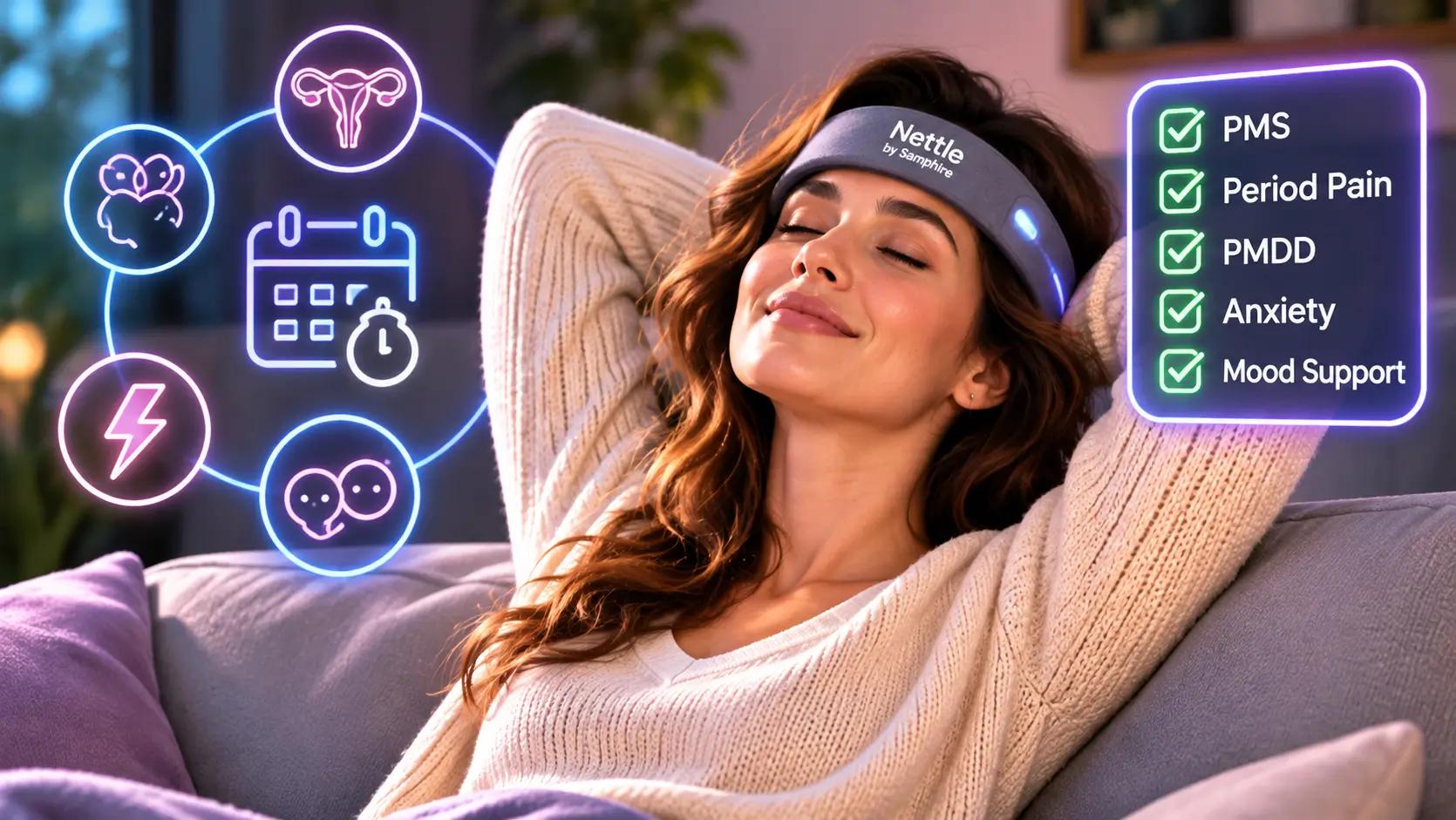
Most period care still comes down to painkillers or hormones. Nettle, a headband from London start-up Samphire Neuroscience, takes a different route: it uses transcranial direct current stimulation (tDCS) to target the brain areas behind period pain and premenstrual mood symptoms.
It’s back in the news this month. On November 5, Samphire announced UK and EU approval for managing anxiety symptoms of PMDD (premenstrual dysphoric disorder), alongside new independent trial results reported by IEEE Spectrum. Here’s my honest take on what it does, what the evidence shows and what else you can try.
In this article
Nettle at a Glance
| What it is | A four-electrode tDCS headband controlled by the Samphire app |
| Made for | Period pain, PMS mood symptoms and, in the UK and EU, PMDD anxiety |
| How you use it | 20 minutes a day in the days before your period |
| Approvals | CE-marked Class IIa medical device in the UK and EU. Sold as a wellness device called Lutea in the US |
| Price | Around £449 in the UK at one major retailer. Samphire shows local pricing at checkout |
How Nettle Works
Nettle sends a weak, steady current through four sponge electrodes. Two sit over the dorsolateral prefrontal cortex (DLPFC), a region linked to mood and emotional control. The other two sit over the motor cortex, which plays a role in how the brain processes pain.
That two-target design is what sets it apart. The Flow headset, for example, only targets the DLPFC for depression. Nettle tries to tackle pain and mood in one session.
You soak the sponges in saline, put the headband on, start a 20-minute session in the app and repeat daily during the late luteal phase (the days before your period). The app helps you schedule sessions around your own cycle rather than assuming a textbook 28 days.
What the Evidence Shows
This is where I want to be careful, because the numbers you’ll see quoted come from different kinds of studies.
Samphire’s own trial
Samphire’s WIND trial, run with academic partners, reported that after five daily sessions before one period, average pain fell by 53% and PMS mood symptoms improved by 34%. Those are encouraging figures, but they’re company-reported and describe how users changed over time, so they don’t on their own tell you how much was down to stimulation versus placebo.
The new independent study
The more telling result is the new study led by Paul Faulkner at Queen Mary University of London. 42 participants used Nettle or a sham version for 20 minutes a day over the two weeks before their period. Compared with sham, the active group reported anxiety symptoms less often after the first month, but there was no difference in depressive symptoms. Faulkner suggested a strong placebo response may explain part of that. The results haven’t been peer-reviewed yet.
The wider research
Independent of Samphire, small sham-controlled trials of tDCS for period pain have shown promise, and a larger NHS trial of Nettle for endometriosis-related pelvic pain is running at University College London Hospital until 2027.
My read: the evidence is promising and moving in the right direction, especially for pain and anxiety. It’s earlier than the evidence behind Flow for depression, so go in with realistic expectations. If you’re curious about why sham-controlled results matter so much, I unpacked it in does at-home tDCS actually work?
Pros and Cons
Pros
- Drug-free and hormone-free
- Targets both pain and mood in one session
- Medical device approval in the UK and EU
- Short sessions, only in the days you need them
- Cycle-aware app with symptom tracking
Cons
- Pricey compared with general tDCS devices
- Independent evidence is still small and partly unpublished
- No clear effect on depressive symptoms in the latest study
- Single-use sponges are an ongoing cost
- Wellness device only in the US
Who Nettle Is (and Isn’t) For
Worth considering if you have regular period pain or premenstrual mood symptoms, you’d like to avoid or reduce painkillers or hormones, and you’re happy to commit to daily sessions before each period.
Not a replacement for medical care if you have severe PMDD, especially with thoughts of self-harm, or pain that could point to endometriosis or another condition. Samphire itself says Nettle may not be appropriate as a primary treatment for PMDD. As with any tDCS device, avoid it if you have epilepsy, metal implants in your head or an implanted device, and check with your doctor if you’re pregnant.
Nettle Alternatives
Nettle is the only tDCS device built specifically for menstrual health, so the right alternative depends on which symptom bothers you most.
| Main symptom | Alternative | Why |
|---|---|---|
| Period cramps | A TENS unit | Pads on the lower belly or back. Well studied for period pain and inexpensive |
| Anxiety and poor sleep | Fisher Wallace Stimulator | A CES device that’s FDA-cleared for anxiety and insomnia |
| Low mood or depression | Flow headset | The strongest evidence for depression of any home device |
| Want a flexible tDCS device | NeuroMyst Pro or TheBrainDriver v2.1 | Cheaper general-purpose tDCS, but not designed or tested for menstrual symptoms |
TENS for period cramps
If cramps are your main problem, a TENS unit is the most practical first step. It stimulates nerves in the skin rather than the brain, works during the pain itself and costs a fraction of Nettle. It won’t help with mood.
Fisher Wallace for anxiety and sleep
If premenstrual anxiety and broken sleep are what drag you down, CES is worth a look. The Fisher Wallace Stimulator is FDA-cleared for anxiety and insomnia, though it isn’t tested specifically for PMS. Learn more in my guide to cranial electrotherapy stimulation.
Flow for low mood
If your low mood lasts beyond the premenstrual days, it may be depression rather than PMS, and that’s worth raising with your doctor. Flow is FDA-approved for depression and has the strongest trial behind it. See my Flow review.
General-purpose tDCS devices
Devices like NeuroMyst Pro and TheBrainDriver cost much less than Nettle and let you choose electrode placements yourself. The trade-off is that they’re not built or tested for menstrual symptoms, and getting placement right is on you. If you go this way, follow published protocols and talk to a clinician. My best tDCS headsets guide compares them.
Don’t skip the standard options
Anti-inflammatory painkillers, hormonal contraception and, for PMDD, certain antidepressants and CBT are well-established treatments. A device can sit alongside them, not instead of a proper conversation with your doctor.
My Verdict
Nettle is one of the most thoughtful consumer tDCS products I’ve seen: a clear purpose, a sensible two-target design and a company that keeps putting it through trials, including independent and NHS ones. The evidence is promising for pain and anxiety but still early, and the price is steep. If period pain or premenstrual anxiety genuinely disrupts your life and the usual options haven’t worked, it’s a reasonable thing to try with your doctor’s blessing.
Frequently Asked Questions
Does Nettle work?
Early evidence is promising. Samphire’s own trial reported a 53% average drop in period pain after one cycle, and a new independent study found less anxiety than with sham, but no difference for depressive symptoms. Larger peer-reviewed trials are still under way.
What is the difference between Nettle and Lutea?
They’re the same Samphire headband. It’s sold as Nettle in the UK and EU, where it’s a medical device, and as Lutea in the US, where it’s sold as a wellness device.
Can Nettle treat PMDD?
In the UK and EU it’s now approved to help manage anxiety symptoms of PMDD. It isn’t a full PMDD treatment, so keep your doctor involved, especially if symptoms are severe.
What are the best Samphire Neuroscience alternatives?
It depends on your main symptom: a TENS unit for period cramps, the Fisher Wallace Stimulator for anxiety and sleep, Flow for depression, or a general tDCS device like NeuroMyst Pro if you want flexibility.
Is Nettle safe?
tDCS at these settings has a good safety record. The usual side effects are tingling, itching or redness under the electrodes. People with epilepsy, head implants or implanted devices shouldn’t use it.
This article is for information only and isn’t medical advice. If you’re struggling with severe premenstrual symptoms or thoughts of self-harm, please contact your doctor or local emergency services. See our medical disclaimer.