

Your heart rate and step count are one thing. Your brainwaves are another. This month, a yearlong investigation by the journal Science, reported with the Pulitzer Center’s AI Accountability Network, found that some consumer neurotech companies have been using customers’ brain recordings to train artificial intelligence, without saying so clearly.
If you’re shopping for a brain device, privacy deserves a spot on your checklist. Here’s what happened, which kinds of devices actually collect brain data, and what to check before you buy.
In this article
What the Investigation Found
- Brain data is being used to train AI. Consumer EEG companies have built up large collections of users’ brainwave recordings and used them to train “brain foundation models”.
- Muse was a leading example. Interaxon, the maker of the Muse headband, told Science it trained an AI model on about 50,000 hours of users’ EEG recordings, described as de-identified. It revised its privacy policy after journalists asked questions.
- Privacy policies often said nothing. Across the dozens of EEG device makers reviewed, several had no privacy policy at all, and others had policies covering only website visitors, not the brain data their devices collect.
None of this means your device is doing anything sinister. But brain data can reveal things like attention, fatigue and sleep patterns, and once it’s in a training set, you can’t take it back.
Not All Brain Devices Collect Brain Data
This is the part most coverage misses. There’s a big difference between devices that read your brain and devices that stimulate it.
| Device type | Examples | Collects brain recordings? | Privacy risk |
|---|---|---|---|
| EEG headbands and headphones | Muse, Neurable MW75 Neuro | Yes, that’s their job | Highest: check the policy carefully |
| App-connected stimulation headsets | Flow, Nettle | No EEG, but apps log sessions, mood or symptom data | Moderate: health data still matters |
| Standalone tDCS stimulators | TheBrainDriver, NeuroMyst Pro | No | Lowest: little or no data leaves the device |
tDCS devices send a weak current into the brain. They don’t record brain activity, so there are no brainwaves to harvest. Some still pair with an app, so it’s worth checking, but a simple stimulator like TheBrainDriver works without any account at all.
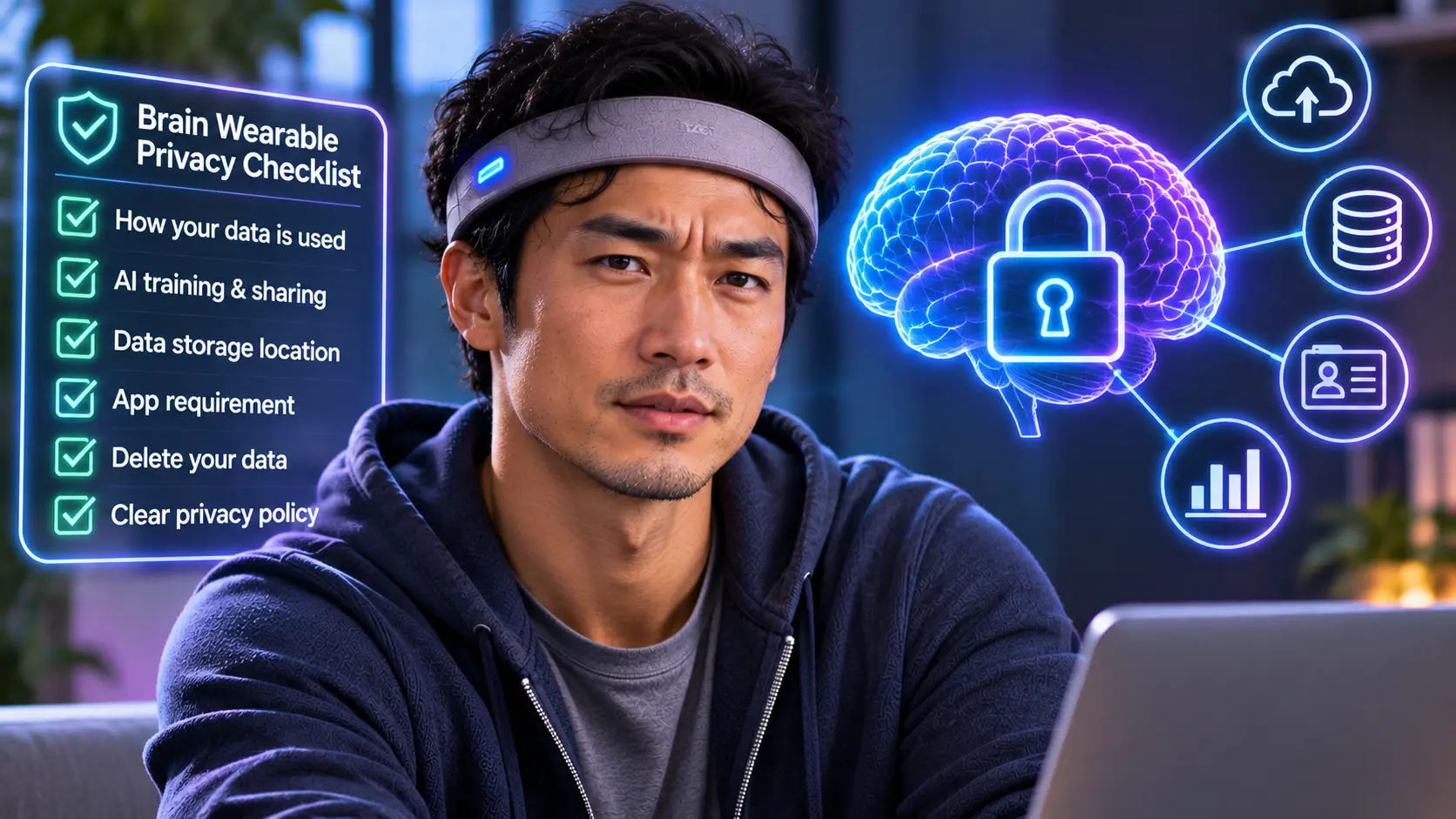
Your 6-Point Brain Wearable Privacy Checklist
- How is your data used? The privacy policy should name brain or EEG data specifically, not just “usage data”.
- Is it used for AI training or shared? Look for the words “research”, “model training”, “partners” or “third parties”, and whether you can opt out.
- Where is it stored? Data kept on your phone is safer than data uploaded to a company’s cloud. Check the country too, since data laws differ.
- Is an app required? If the device only works through an app with an account, assume data leaves your phone.
- Can you delete your data? A good policy explains how to download and permanently delete your recordings.
- Is the policy clear and current? No policy, or one that only covers the website, is a red flag. So is a policy that quietly changes after you buy.
Privacy-Friendly Picks
If privacy is a priority, a standalone tDCS stimulator is the safest category. They’re for stimulation rather than tracking, so they suit people who want to try tDCS for mood, focus or cravings without sharing any brain data.
1. NeuroMyst Pro
My top pick for flexibility: tDCS and tACS, adjustable current and session length. Check the current version’s app requirements before you buy if privacy is your main concern. Read my NeuroMyst Pro review.
2. TheBrainDriver v2.1
No app, no account: four fixed current levels and an auto shut-off timer. The most private way to try tDCS. Code tdcscom gives 5% off. Read my TheBrainDriver review.
If you do want brain tracking, for sleep or meditation, an EEG headband can still be worth it. Just read the privacy policy first, turn off research or data-sharing options where you can, and keep the checklist above handy. My best tDCS headsets guide explains the difference between EEG headphones and stimulation devices.
Frequently Asked Questions
Do brain wearables collect your data?
EEG devices like Muse record your brainwaves, and a 2026 Science investigation found some makers used those recordings to train AI without clearly telling users. Stimulation-only tDCS devices don’t record brain activity.
Did Muse use brain data to train AI?
Muse’s maker, Interaxon, told Science it trained an AI model on about 50,000 hours of de-identified user EEG recordings. It updated its privacy policy after journalists asked about it.
Do tDCS devices collect brain data?
No. tDCS devices stimulate the brain with a weak current and don’t record brain activity. App-connected ones may log sessions or mood data, so check the app’s privacy policy.
How do I protect my brain data?
Read the privacy policy before buying, look for AI training and sharing clauses, opt out of research programs, prefer local storage and use the delete option if you stop using the device.
Company practices and policies change. This article reflects reporting as of November 2026. See our medical disclaimer.